You are here: Home » News » What Is PPH Pipe Fittings?
What Is PPH Pipe Fittings?
Views: 0 Author: Site Editor Publish Time: 2026-05-08 Origin: Site
Introduction to PPH Pipe Fittings
PPH (Polypropylene Homopolymer) pipe fittings are high-quality plastic components used to connect and manage piping systems across various industries. Known for their durability, corrosion resistance, and chemical stability, PPH fittings are ideal for both industrial and domestic applications. From water supply systems to chemical plants, these fittings ensure safe and efficient fluid transportation.
Material & Standards of PPH Pipe Fittings
PPH pipe fittings are made from polypropylene homopolymer, which provides excellent resistance to acids, alkalis, and high temperatures up to 95°C (203°F). They are lightweight yet robust, ensuring easy handling and long service life.
Common Standards Include:
DIN 8077 / 8078 – German standard for polypropylene pipes
ISO 15874 – International standard for plastic piping systems
ASTM D4101 – Standard specification for polypropylene
Meeting these standards guarantees that the fittings are reliable, leak-free, and compatible with various piping systems.
Features & Advantages of PPH Pipe Fittings
PPH pipe fittings offer several key benefits:
Corrosion Resistant: Unlike metal fittings, PPH is immune to rust and chemical damage.
Durable and Long-lasting: Lifespan exceeds 50 years under proper conditions.
Lightweight & Easy to Install: Simplifies construction and reduces labor costs.
High Chemical Resistance: Ideal for transporting acids, alkalis, and other aggressive chemicals.
Cost-Effective: Lower maintenance and replacement costs compared to metal alternatives.
Compared to PVC and CPVC fittings, PPH provides better chemical resistance and higher temperature tolerance, making it a preferred choice in demanding applications.
Applications of PPH Pipe Fittings
PPH fittings are versatile and used in multiple industries:
Industry
Applications
Domestic Water Supply
Hot and cold water plumbing systems
Chemical Industry
Transport of acids, alkalis, and solvents
Food & Beverage
Pipelines in food processing facilities
Pharmaceutical
Safe and contamination-free piping systems
Industrial Plants
Cooling, heating, and drainage pipelines
Their combination of durability, safety, and chemical resistance makes them a universal choice across these sectors.
How PPH Pipe Fittings Work
PPH fittings connect pipes using several methods:
Socket Welding (Heat Fusion): Pipes and fittings are heated and fused together to form a seamless joint.
Mechanical Joints: Some systems use compression fittings for easy assembly and disassembly.
Butt Fusion: Pipes are joined end-to-end using heat for a strong, leak-proof connection.
These methods ensure that piping systems are secure, leak-free, and capable of withstanding pressure and temperature fluctuations.
Common Sizes and Types of PPH Pipe Fittings
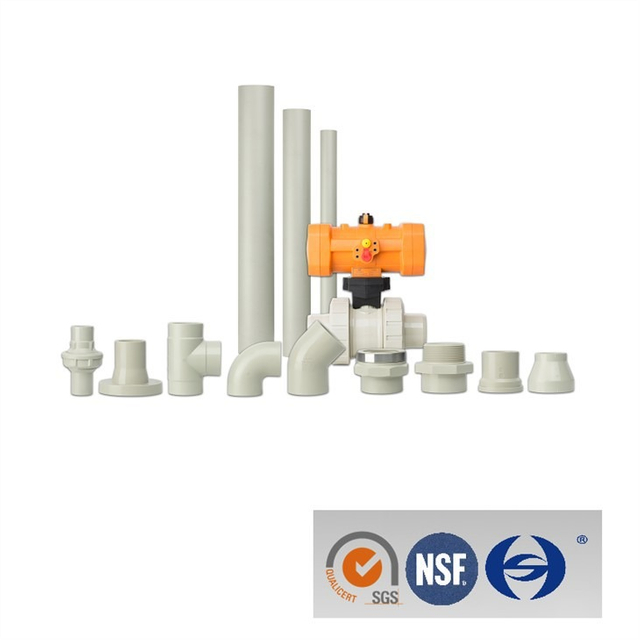
PPH fittings are available in various types to accommodate different piping needs:
Elbows (90°, 45°) – For directional changes
Tees & Reducing Tees – For branching connections
Couplings & Reducers – To connect pipes of different diameters
Flanges & End Caps – For system closures and maintenance access
Valves – For flow control
Offering a wide range of fittings ensures compatibility with most PPH piping systems.
Leading PPH Pipe Fittings Manufacturers in 2026
Many companies manufacture PPH fittings globally, but Huasheng Pipe stands out for its high-quality products and ISO-certified production.
Project Cases of HUASHENG PPH Pipe Fittings
Chemical Plant Piping Project
HUASHENG supplied a complete PPH piping system for a chemical manufacturing project in Southeast Asia. The customer required corrosion-resistant pipe fittings for acid and alkali transportation under high-temperature operating conditions.
Our PPH pipe fittings provided:
Excellent chemical resistance
Stable high-temperature performance
Long service life
Easy installation and welding
The system has been operating reliably in a highly corrosive industrial environment for many years.
Semiconductor Water Treatment Project
In a semiconductor manufacturing facility, HUASHENG PPH pipe fittings were used in ultrapure water and chemical transfer systems.
The customer selected PPH fittings because of:
High-purity material performance
Smooth inner wall reducing contamination
Excellent corrosion resistance
Reliable socket fusion connections
PPH piping systems are widely used in semiconductor and electronic industries where cleanliness and stability are essential.
Industrial Wastewater Treatment Project
A large environmental engineering company used HUASHENG PPH pipe fittings in its industrial wastewater treatment project.
The system included:
Chemical dosing pipelines
Corrosive liquid transportation
Industrial fluid transfer systems
Compared with traditional metal pipes, PPH pipe fittings offered better corrosion resistance, reduced maintenance costs, and longer service life.
Petrochemical Industry Project
HUASHENG PPH pipe fittings are also widely used in petrochemical plants and refinery pipeline systems.
Because of their:
Excellent chemical resistance
High-temperature capability
Long-term durability
Lightweight installation advantages
PPH piping systems are ideal for industrial process pipelines and aggressive chemical environments.
Why Choose Huasheng Pipe?
More than 35 years of manufacturing experience
Exported to over 50 countries
ISO-certified production system
Complete range of PPH pipes, fittings, and valves
OEM & customized industrial piping solutions
Reliable quality for global industrial projects
By choosing Huasheng Pipe, customers ensure safe, durable, and cost-effective piping solutions.
Conclusion: Why Choose PPH Pipe Fittings?
PPH pipe fittings combine durability, chemical resistance, and cost-effectiveness, making them suitable for a wide range of applications. Whether for industrial plants, food processing, pharmaceuticals, or domestic water systems, PPH fittings ensure long-lasting, leak-free performance.

 English
 العربية
 Français
 Русский
 Español
 Português
 Deutsch
 italiano
 日本語
日本語 한국어
한국어 Nederlands
 Tiếng Việt
 ไทย
ไทย Polski
 Türkçe
 ພາສາລາວ
 ភាសាខ្មែរ
 Bahasa Melayu
 ဗမာစာ
ဗမာစာ Filipino
 Bahasa Indonesia
 magyar
 Română
 Čeština
 Монгол
 қазақ
қазақ Српски
 हिन्दी
 فارسی
فارسی Kiswahili
 Norsk
Norsk Svenska
 українська
 Ελληνικά
 Suomi
Suomi עברית
עברית Dansk
Dansk اردو
اردو বাংলা
বাংলা Hrvatski
 Gaeilge
 සිංහල
සිංහල नेपाली
 Oʻzbekcha
 Euskara
 Беларуская мова
 Български
 Hausa
Hausa íslenska
 پښتو
پښتو isiZulu